The Big Green-Little Green Intergenerational Project
The Foster Grandparent Program, sponsored by the Council on Aging of West Florida, Inc., has been assisting low income and special needs children in Escambia and Santa Rosa Counties since 1985. The initial placement of 50 volunteers in schools and other child service centers has grown to today’s 71 who mentor over 200 children annually.
In a county where the children face academic challenges – Escambia held the dubious distinction of having the only two “F” schools in the state the first year that standardized testing was conducted and 59% of the children are eligible for Reduced or Free Lunches—it was recognized that they are under-enriched in areas beyond reading and arithmetic. Realizing the need for hands-on knowledge that may engender a lifelong appreciation of science, stewardship and the nature that surrounds them, the seeds of Big Green-Little Green were sown.
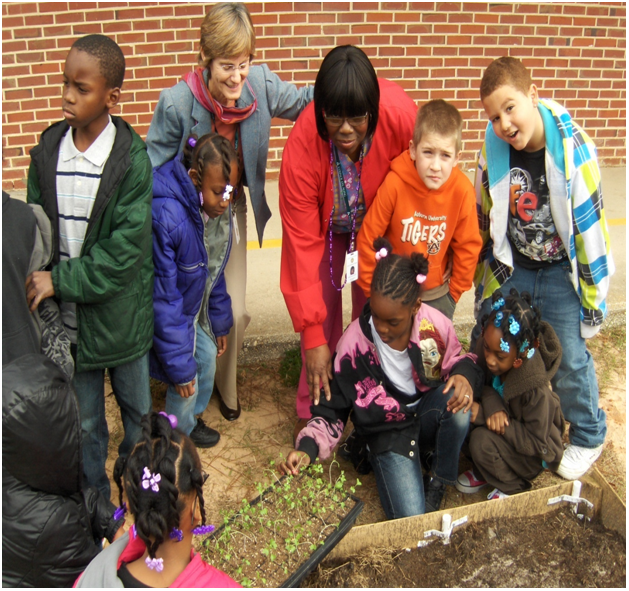
Big Green-Little Green, so named because the Foster Grandparent (the Big) would be helping a child (the Little), was funded by a grant from International Paper. A children’s librarian guided us in the selection of books, supplies, and activity guides for ten classrooms. Professionals from the community, including an extension agent from the University of Florida’s Institute of Food and Agricultural Sciences, a “green builder”, and Manna Food Bank’s coordinator of community gardening, augmented the Foster Grandparents’ knowledge base.
The children ages 5 through 10 learned age appropriate environmental stewardship in recycling, energy conservation, and plant and garden cycles. To further their literacy skills, they read books such as Adventures of a Plastic Bottle, From the Garden, and Dinosaurs Go Green. Parents were encouraged to become involved as the projects on water conservation and litter prevention were incorporated into homework activities and writing assignments. The gardens now yield such Southern delicacies as collards, okra, and tomatoes, which the students enjoy at the school, take home with them, and share with Manna.
Teachers incorporated the topics cross stream so the children understood the relationship between the environmental projects and their Real Life application to math, reading, science and social studies.
Pre and post testing showed an increase in the children’s knowledge base. A kindergarten class reported that only one child had recycled at the beginning of the project period but by its end, all were. In a third grade class, the numbers rose from 14% to 71%, with 43% now also recycling at home.
One fifth grade teacher said the value of Big Green-Little Green was that it enabled the students to see beyond themselves [to] how we can all benefit from being globally responsible.
This project was initiated prior to the BP oil spill. As Pensacola residents, we are acutely aware of the need for the stewardship of our resources. Because several teachers expressed an interest in conducting the project in their classrooms, as grant dollars become available, it is our intention to expand to involve our Foster Grandparents in helping students begin sound stewardship habits to last a lifetime.
0 comments